Introduction
The Large Sky Area Multi-Object Fiber Spectroscopic Telescope (LAMOST) is a quasi-meridian reflecting Schmidt telescope located at the Xinglong Station of the National Astronomical Observatories of China (NAOC). With an effective aperture of 3.6–4.9 m and a 5-degree field of view in diameter, it is equipped with 4000 robotic fibers feeding 16 spectrographs, making it uniquely powerful for large-scale spectroscopic surveys (Cui et al. 2012) . The spectral resolution reaches R~1800 and each spectrum covers 3700–5900 Å for the blue channel and 5700–9000 Å for the red channel.
The LAMOST regular survey, ongoing since September 2012, consists of two major components: the LAMOST ExtraGAlactic Survey (LEGAS) and the LAMOST Experiment for Galactic Understanding and Exploration (LEGUE) survey of Milky Way stellar structure (Zhao et al. 2012). The LAMOST quasar survey, conducted under LEGAS, aims to census quasars across a wide redshift range to study the growth of supermassive black holes (SMBHs) and their co-evolution with host galaxies.
Target Selection
The target selection methodology for DR10-12 follows the well-established procedures detailed in earlier works .
Candidate quasars are primarily selected from point sources in the Sloan Digital Sky Survey (SDSS) photometric catalog, within an i-band magnitude brighter than 20.0 mag to ensure data quality. The selection employs a combination of:
- Optical-Infrared Colors: Sources are cross-matched with datasets from the UKIRT Infrared Deep Sky Survey (UKIDSS) and the Wide-field Infrared Survey Explorer (WISE). Selection is based on their location in multi-dimensional SDSS and UKIDSS/WISE color space (Wu & Jia 2010, Wu et al. 2012).
- Data-Mining Algorithms: Heterogeneous algorithms, including Support Vector Machine (SVM), are used in conjunction with color selection.
- Multi-Wavelength Data Matching: The input catalog is supplemented by matching SDSS photometry with sources detected in X-ray (XMM-Newton, Chandra, ROSAT) and radio (FIRST, NVSS) surveys.
- The GPQ candidates catalog and the CatNorth quasar candidate catalog constructed using a transfer learning algorithm (Y. Fu et al. 2021, 2024).
Quasar Identification
After observation, spectra are processed by the LAMOST 1D pipeline and initially classified into four categories: “QSO,” “GALAXY,” “STAR,” and “Unknown”. The 13,217 spectra automatically labeled as “QSO” by the pipeline and 1946 spectra
of quasar candidates from the input catalog of LAMOST were subjected to visual inspection to confirm their identities with the help of a Java-based program, ASERA
(H. Yuan et al. 2013). When the spectrum features match the quasar template, the corresponding object was classified as a quasar, and the redshift was determined when at least one typical quasar emission line (e.g., Hα, Hβ, O IIIλ5007, Mg II,
C III, and C IV) was confidently identified. In cases where only one clear emission line was present and matched, the spectrum was flagged as “ZWARNING = 1” to indicate a lower confidence in the redshift measurement. Unlike previous releases that used SDSS or Pan-STARRS1 photometry, the spectra in this release are calibrated using high-precision, contemporaneous g and r-band photometric data from the Zwicky Transient Facility (ZTF). This ZTF data provides a more accurate calibration and enhances the reliability of subsequent physical measurements.
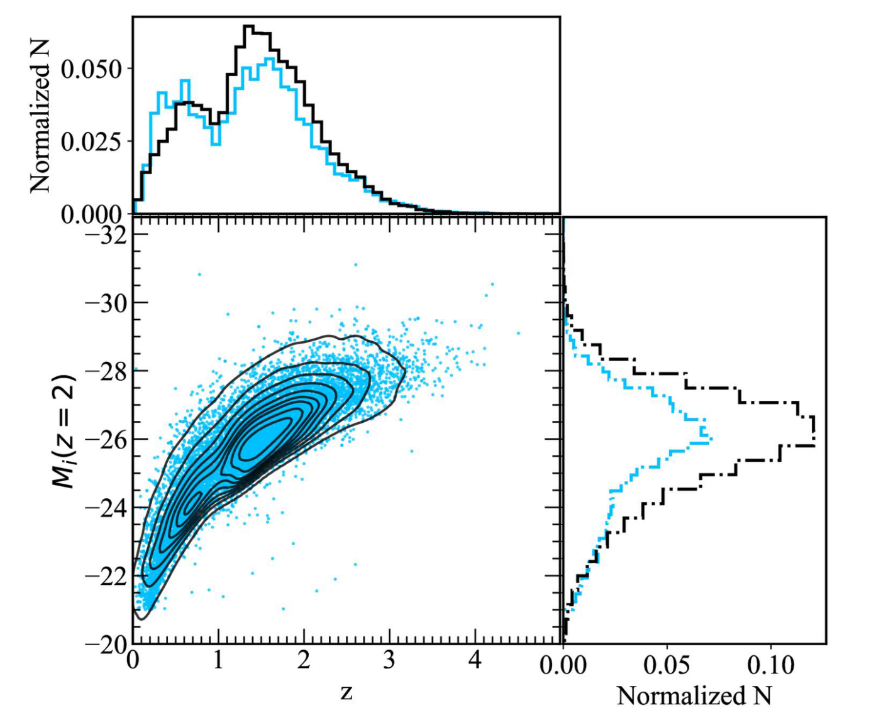
The distribution in the magnitude-redshift space for the visually confirmed quasars for the previous (DR1–9) LAMOST quasar survey (black contours) and in DR10–12 (blue).
Overview
After the 12 yr regular survey, a total of 67,521 quasars have been identified in the LAMOST quasar survey (Ai et al. 2016; Dong et al. 2018; Yao et al. 2019, Jin et al. 2022 and Lyu et al 2026). 40,539 of them are independently discovered, and 29,513 are newly discovered. The LAMOST quasar catalog will provide us with important
applications in searching for rare quasars such as extreme variability quasars (EVQs), changing-look quasars (CLQs), broad absorption line (BAL) quasars, and quasars behind the Galactic plane (GPQs).
Table 1. The summary of the results of the LAMOST quasar survey up to now
|
|
Paper I |
Paper II |
Paper III |
Paper IV |
This Work |
Total |
|---|---|---|---|---|---|---|
|
Total |
3921 |
19,935 |
19,253 |
13,066 |
11,346 |
67,521 |
|
Known |
2741 |
11,835 |
11,091 |
6381 |
5960 |
38,008 |
|
Independent |
1180 |
12,126 |
11,458 |
7102 |
8427 |
40,293 |
|
New |
1180 |
8100 |
8162 |
6685 |
5386 |
29,513 |
Download
| DR10-12 | Download | containing quasars observed between 2021.09.01 and 2024.06.03. Full content and detailed description can be found in Lyu et al. (2026) |
| DR6-9 | Download | containing quasars observed between 2017.09.19 and 2021.06.11. Full content and detailed description can be found in Jin et al. (2022) |
| DR4-5 | Download | containing quasars observed between 2015.09.12 and 2017.06.16. Full content and detailed description can be found in Yao et al. (2018) |
| DR2-3 | Download | containing quasars observed between 2013.09.10 and 2015.05.30. Full content and detailed description can be found in Dong et al. (2018) |
| DR1 | New Quasars Known Quasars |
containing quasars observed between 2012.09.28 and 2015.06.03. DR1 quasar catalogs are provided seperately into new discoveries and known ones. Full content and detailed description can be found in Ai et al. (2016) |
* Please contact PI if you couldn't find spectrum fits in archive due to the updates of catalogs.
Query Catalog
Query LAMOST Quasar Catalog DR10-12
Query LAMOST Quasar Catalog DR6-9
Query LAMOST Quasar Catalog DR1-5
References
1. "The Large Sky Area Multi-object Fiber Spectroscopic Telescope Quasar Survey: Quasar Properties from the First Data Release ( 2016, AJ, 151, 24)" Ai, Y. L.; Wu, Xue-Bing; Yang, Jinyi; Yang, Qian; Wang, Feige; Guo, Rui; Zuo, Wenwen; Dong, Xiaoyi; Zhang, Y.-X.; Yuan, H.-L.; Song, Y.-H.; Wang, Jianguo; Dong, Xiaobo; Yang, M.; -Wu, H.; Shen, S.-Y.; Shi, J.-R.; He, B.-L.; Lei, Y.-J.; Li, Y.-B.; Luo, A.-L.; Zhao, Y.-H.; Zhang, H.-T.
2. "The Large Sky Area Multi-Object Fibre Spectroscopic Telescope (LAMOST) Quasar Survey: Quasar Properties from Data Release Two and Three (2018, AJ, 155, 189)" Dong, X. Y.; Wu, Xue-Bing; Ai, Y. L.; Yang, J. Y.; Yang, Q.; Wang, F.; Zhang, Y. X.; Luo, A. L.; Xu, H.; Yuan, H. L.; Zhang, J. N.; Wang, M. X.; Wang, L. L.; Li, Y. B.; Zuo, F.; Hou, W.; Guo, Y. X.; Kong, X.; Chen, X. Y.; Wu, Y.; Yang, H. F.; Yang, M.
3. "The Large Sky Area Multi-Object Fiber Spectroscopic Telescope (LAMOST) Quasar Survey: the 4th and 5th Data Release (2019, ApJS, 240, 1)" Yao, Su; Wu, Xue-Bing; Ai, Y. L.; Yang, Jinyi; Yang, Qian; Dong, Xiaoyi; Joshi, Ravi; Wang, Feige; Feng, Xiaotong; Fu, Yuming; Hou, Wen; Luo, A.-L.; Kong, Xiao; Liu, Yuanqi; Zhao, Y.-H.; Zhang, Y.-X.; Yuan, H.-L.; Shen, Shiyin
4."The Large Sky Area Multi-object Fiber Spectroscopic Telescope (LAMOST) Quasar Survey: Quasar Properties from Data Release Six to Nine (2023, ApJS, 265, 25)" Jun-Jie Jin, Xue-Bing Wu, Yuming Fu, Su Yao, Yan-Li Ai, Xiao-Tong Feng, Zi-Qi He, Qin-Chun Ma, Yu-Xuan Pang, Rui Zhu, Yan-xia Zhang, Hai-long Yuan, Zhi-ying Huo
5 "The Large Sky Area Multi-object Fiber Spectroscopic Telescope (LAMOST) Quasar Survey: Quasar Properties from Data Release 10 to 12 (2026, ApJS, 282, 72)” Bing Lyu, Xue-Bing Wu, Jun-Jie Jin, Yuming Fu, Yuxuan Pang, Huimei Wang, Rui Zhu, Su Yao, Yan-Li Ai, Yan-xia Zhang
Acknowledgments
If the LAMOST quasar catalogs have been helpful for your research the following acknowledgment would be appreciated:
This research has made use of data obtained from LAMOST quasar survey. LAMOST is a National Major Scientific Project built by the Chinese Academy of Sciences. Funding for the project has been provided by the National Development and Reform Commission. LAMOST is operated and managed by the National Astronomical Observatories, Chinese Academy of Sciences.
Contact
Prof. Xue-Bing Wu (PI of the LAMOST Quasar Survey), Department of Astronomy & Kavli Institute for Astronmy and Astrophysics, Peking University. Email: wuxb(at)pku.edu.cn