2026 J-PAS XXII Collaboration Meeting
地点 : China-Shanghai 中国-上海
注册时间: 2026.06.15-2026.10.02
活动时间 : 2026.10.19 - 2026.10.23
状态:
活动已结束
J-PAS (Javalambre Physics of the Accelerating Universe Astrophysical Survey) is an unprecedented multi-band photometric survey operated with the 2.55 m JST Telescope and the 120-megapixel JPCam panoramic camera at the Javalambre Observatory in Spain. It is designed to cover approximately 8,500 square degrees of the northern sky. Equipped with a full set of 56 filters consisting of 54 narrowband filters and 2 broadband filters, the survey delivers high-precision photometric data comparable to low-resolution spectra for each celestial object across the optical wavelength range of 350–1000 nm. Its core scientific objective is to construct the first complete three-dimensional map of the Universe. It will not only record the precise positions of hundreds of millions of galaxies and quasars, but also derive their distances using high-accuracy photometric redshift techniques. This enables researchers to explore cutting-edge astrophysical topics including the nature of dark energy, the evolution of large-scale cosmic structures, as well as the formation and evolution of galaxies with unprecedented precision.
J-PAS is a large-scale international scientific collaboration with a global network. It brings together over 250 researchers from 18 countries to conduct scientific research and data exploitation. The leading institutions include the Centro de Estudios de Física del Cosmos de Aragón (CEFCA) and the Instituto de Astrofísica de Andalucía (IAA-CSIC) in Spain, as well as the National Observatory of Rio de Janeiro and the University of São Paulo in Brazil.Adopting the consortium model of major scientific projects similar to the European Organization for Nuclear Research (CERN), J-PAS grants data access rights and seats on the Science Committee based on contributions from participating parties.
China is a key member of the J-PAS consortium. Its participating institutions consist of the National Astronomical Observatories and the Shanghai Astronomical Observatory of the Chinese Academy of Sciences, along with prestigious universities including Tsinghua University, Beijing Normal University, Xiamen University and the University of Chinese Academy of Sciences.
The annual J-PAS Consortium Meeting is hosted alternately by member countries every year to facilitate academic exchanges and coordination among the global team.
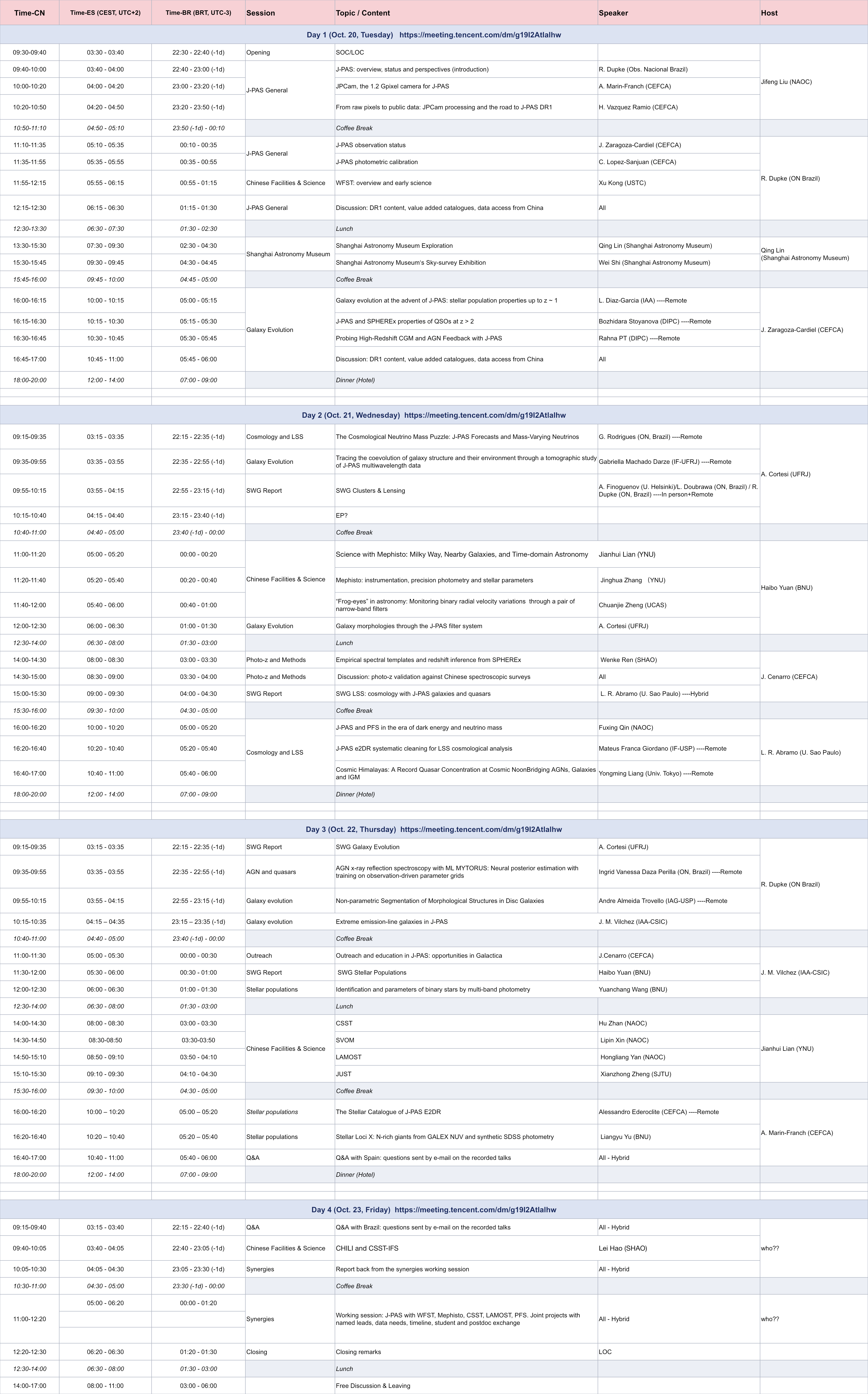
This year will mark the first time the annual meeting is held in China, organized by the Shanghai Astronomical Observatory (SHAO), CAS.
Scientific Organizing Committee:
- Alexis Finoguenov
- Arianna Cortesi
- Haibo Yuan (BNU, China)
- Zhen-Ya Zheng (SHAO, China)
- Raul Abramo
- Renato Dupke
- Jifeng Liu (NAOC, China)
Local Organizing Committee:
- Zhen-Ya Zheng (Chair, SHAO, China)
- Qing Lin (Shanghai Astronomy Museum, China)
- Yang Yang (SHAO, China)
Meeting Information:
On-site Registration Time: 2026-10-19 15pm-20pm
Meeting Time: 2026-10-20—23, 9:30am-5:00pm
Conference Fee:
| Foreigner | 150 € |
| Chinese | 1000 ¥ |
Conference location:
Shanghai Astronomy Museum (Branch of Shanghai Science and Technology Museum)
上海天文馆(上海科技馆分馆)
No. 380 Lingang Avenue, Pudong New Area, Shanghai (postal code: 201306)
上海市浦东新区临港大道380号