Data Release

HyperMillennium

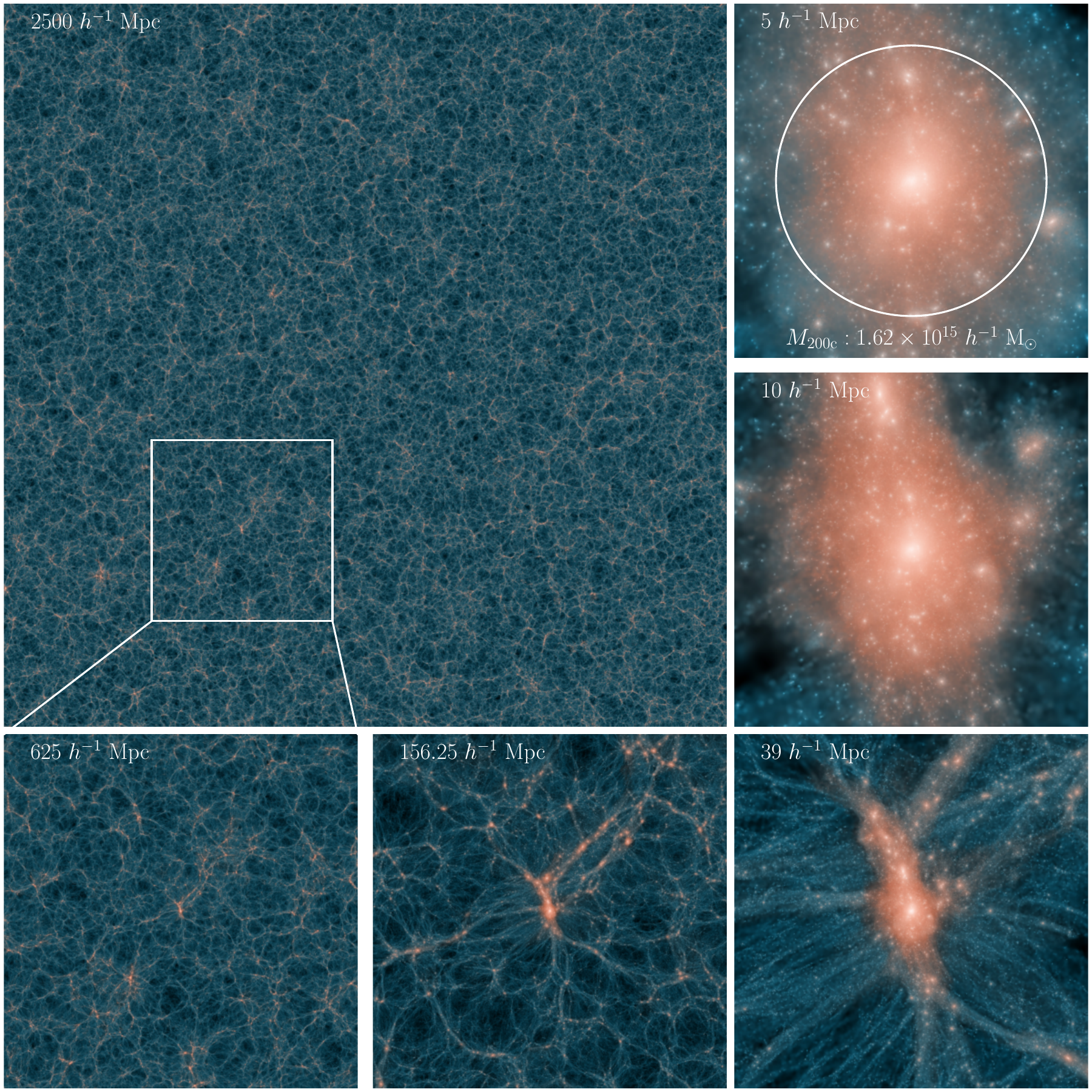
The HyperMillennium simulation (Chinese name: Qianyan) is an ultra-large cosmological N-body simulation that evolves about 4.2 trillion dark matter particles in a comoving box of 2.5 h−1Gpc on a side, with a mass resolution of 3.2×10⁸ h−1M and a force resolution of 3.0 h−1kpc.

Simulation Summary

The HyperMillennium simulation is an ultra-large cosmological N-body simulation designed to support next-generation galaxy surveys. It evolves about 4.2 trillion dark matter particles in a comoving box of 2.5 h−1Gpc on a side, achieving a mass resolution of 3.2×10⁸ h−1M and a force resolution of 3.0 h−1kpc.

The HyperMillennium (HM) simulation is performed with the PhotoNs-3.7 code. Gravity is computed using a hybrid PM-FMM scheme with O(N) complexity, and more than 90% of the particle-pair calculations are offloaded to GPU cores on heterogeneous supercomputers. The simulation outputs 100 snapshots from z=20.4 to 0 and requires about 12 PB of storage.

The full simulation provides particle snapshots, FoF groups and substructure catalogues, and merger trees. Galaxies are then populated using the semi-analytic model L-GALAXIES, which includes prescriptions for gas cooling, star formation, feedback, AGN heating, stellar population synthesis, and JWST/NIRCam broadband magnitudes. The current first release is derived from the lead paper and is now organised as 18 files, including nine halo mass files and nine uniformly renamed semi-analytic galaxy catalogues matched to the corresponding Abell 2744 analogues.

HyperMillennium large-scale structure map
Large-scale structure preview of HyperMillennium across an ultra-large cosmological volume.

Research Summary

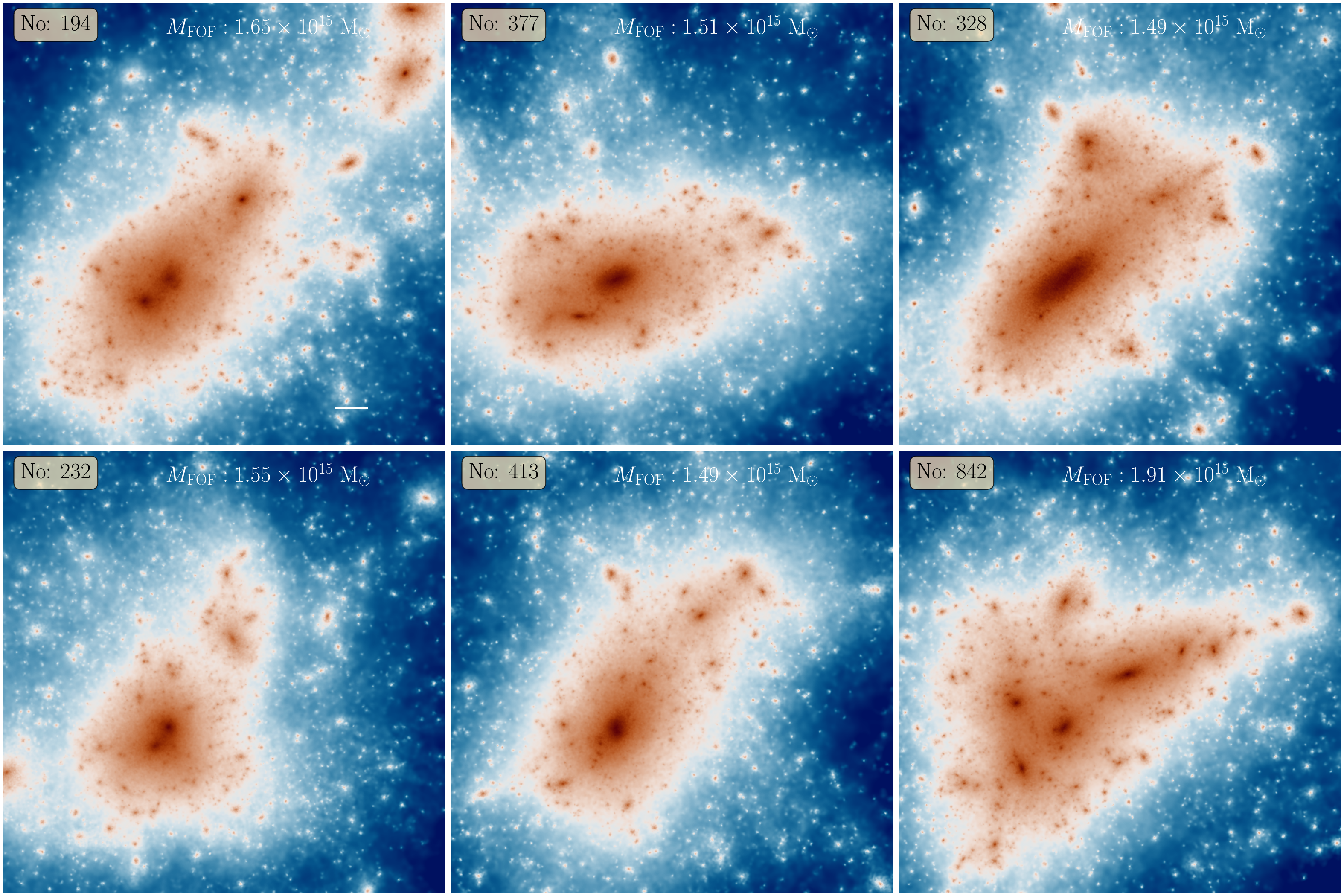
High-resolution composite view for Abell 2744 analogue analysis
Comparison view of Abell 2744 analogues in an extreme cluster environment.

In the lead paper of the HyperMillennium project, we search for analogues of Abell 2744 (A2744), a massive galaxy cluster with puzzling substructures. Using Procrustes geometric morphometry, we identify simulated haloes that best match the configuration of the five brightest member galaxies in A2744 from a sample of more than 800 haloes with MFOF > 1015 h−1M.

These analogues are populated with galaxies using the semi-analytic model L-GALAXIES, and mock JWST/NIRCam images together with lensing convergence maps are generated for comparison with the observed cluster.

Once the observational bias of the JWST field toward high galaxy surface density is properly accounted for, the pixel-based statistics of galaxy number density, luminosity density, and projected mass density show excellent agreement between A2744 and its simulated analogues down to about 50 kpc. This concordance demonstrates the robustness of HyperMillennium and its galaxy formation modelling in one of the most extreme cluster environments.

Data Download

Contact

Ming Li mingli(at)nao.cas.cn

Data Service

National Astronomical Data Center support(at)china-vo.org

Phone +86-10-64807973