Pan-STARRS All-sky Catalog
The Pan-STARRS all-sky catalog are composed of two parts. The first part, referred to as Northern Pan-STARRS, consists of PS1 DR1 data north of declination −30°, which we have carefully calibrated to achieve milli-magnitude precision. The second part, referred to as Southern Pan-STARRS, is derived from SkyMapper DR4 data, which we have transformed onto the Pan-STARRS photometric system to provide consistent coverage south of declination −30°.
Northern Pan-STARRS
Xiao et al. (2023) conducted an independent validation and recalibration of PS1 photometry by combining spectroscopic data from LAMOST DR7 and photometric data from the corrected Gaia EDR3, applying Stellar Color Regression (SCR) methods—including the spectroscopy-based SCR, photometry-based SCR, and the Gaia BP/RP synthetic photometry approach. Using approximately 1.5 million matched LAMOST–PS1–Gaia stars per band as calibration standards, they showed that the photometric calibration precision of PS1 in the grizy filters reaches about 4–7 mmag when averaged over 14–20'' regions. Despite this high precision, they identified significant large- and small-scale spatial variations in magnitude offsets, up to over 1%, across all filters, with slightly larger errors in the g and y bands. These variations are likely due to systematic calibration errors in PS1, particularly in crowded fields such as the Galactic plane, where the errors can reach up to 0.04 mag. Xiao et al. also detected moderate magnitude-dependent errors (0.003–0.005 mag per magnitude within the 14–17 mag range), likely caused by systematic uncertainties in the PSF magnitudes. The results obtained from the three SCR methods are consistent within 1–2 mmag for all filters. To enable more accurate calibrations, Xiao et al. provided two-dimensional correction maps at various spatial resolutions (20′ to 160′), along with a Python package for correcting position-dependent PS1 magnitude offsets, supporting high-precision photometric studies and the calibration of other surveys. The Python package developed by Xiao et al. is used to correct the entire PS1 dataset, and the resulting recalibrated dataset is referred to as the Northern PS1.
Southern Pan-STARRS
Here, we transform the SkyMapper DR4 data to the Pan-STARRS system to construct the Southern Pan-STARRS catalog. The procedure is outlined as follows:
1. The PS1 XPSP photometric data are combined with Gaia DR3 and SkyMapper DR4, with a cross-matching radius of 1".
2. The WCS coordinates and Gaia distances (1/parallax) of the matched stars are input into the 3D extinction map program (Wang et al. 2025) to obtain the extinction values .
3. Based on the relation in Figure 1 of Huang et al. (2025), we select dwarf and giant star samples. For both types of stars, the following criteria are applied to choose reference stars: 1) Gaia phot_bp_rp_excess_factor < 1.3+0.06*(GBP-GRP)2 to avoid bad Gaia photometry; 2) 0.6 ≤ (GBP−GRP)0 ≤ 1.5; 3) photometric errors in ugriz less than 0.01 mag; 4) the relative error of Gaia parallax less than 20; 5) E(B-V) < 0.02 mag.
4. Six intrinsic colors are defined as follows:
(GBP-GRP)0=GBP-GRP-1.25*E(B-V),
(gSMSS-gPS1)0=gSMSS-gPS1-0.188*E(B-V),
(rSMSS-rPS1)0=rSMSS-rPS1-0.329*E(B-V),
(iSMSS-iPS1)0=iSMSS-iPS1-0.165*E(B-V),
(zSMSS-zPS1)0=zSMSS-zPS1-0.099*E(B-V),
(zSMSS-yPS1)0=zSMSS-yPS1-0.351*E(B-V).
For the reference stars, a third-/fourth-order one-dimensional polynomial is used to fit the intrinsic colors as a function of (GBP-GRP)0.
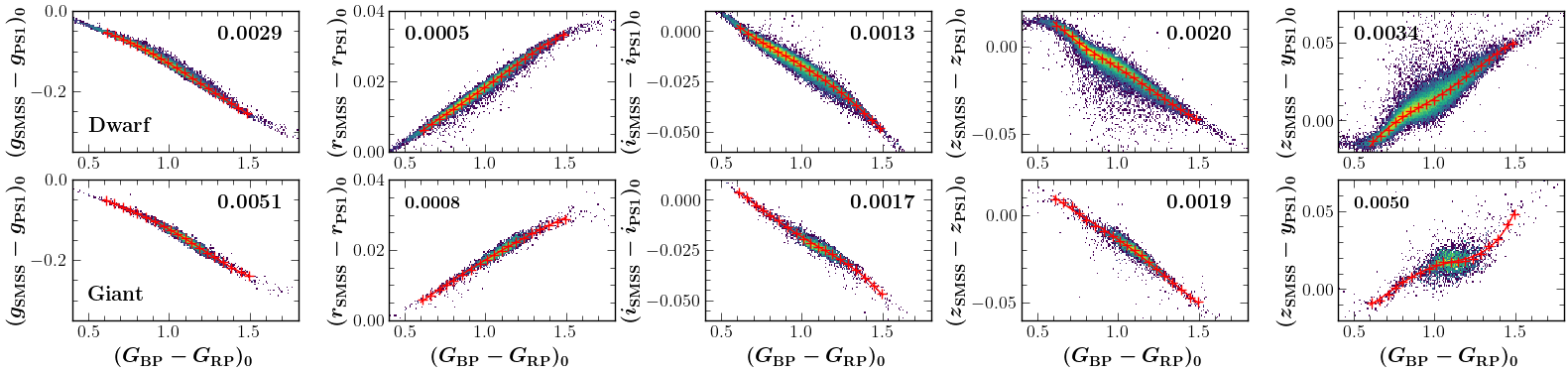
Figure 1. A one-dimensional third-/fourth-order polynomial fit of intrinsic colors as a function of the intrinsic color (GBP-GRP)0 for reference stars is performed. From left to right, the panels correspond to the gSMSS-gPS1, rSMSS-rPS1, iSMSS-iPS1, zSMSS-zPS1, and ySMSS-yPS1 colors, respectively. The top and bottom panels represent dwarfs and giants, respectively. The red points and curves indicate the results for the median value and polynomial fit, respectively. The standard deviation of the residuals is labeled in each panel.
| Intrinsic Color | (GBP-GRP)04 | (GBP-GRP)03 | (GBP-GRP)02 | (GBP-GRP)0 | Constant Term | |||||
| dwarf | giant | dwarf | giant | dwarf | giant | dwarf | giant | dwarf | giant | |
| gSMSS-gPS1 | 0 | 0.3204743 | 0.10909011 | -1.22738281 | -0.40585048 | 1.63279139 | 0.24043437 | -1.08845066 | -0.07403664 | 0.23933064 |
| rSMSS-rPS1 | -0.03192412 | 0 | 0.12338749 | 0 | -0.17308109 | -0.00648514 | 0.13643092 | 0.040493 | -0.03643075 | -0.01684332 |
| iSMSS-iPS1 | 0.0315713 | -0.08846257 | -0.17005346 | 0.325078 | 0.30189972 | -0.42462338 | -0.26858776 | 0.17797805 | 0.08804555 | -0.00837377 |
| zSMSS-zPS1 | 0.08887871 | 0.08222407 | -0.39012273 | -0.34985434 | 0.62880597 | 0.52872407 | -0.50074943 | -0.40056441 | 0.16080345 | 0.12546271 |
| ySMSS-yPS1 | -0.2087885 | 0.37680409 | 0.91214597 | -1.38800026 | -1.45236599 | 1.8244406 | 1.06692718 | -0.95724017 | -0.30386475 | 0.15829346 |
Table1. The Coefficients Used to Obtain Intrinsic Colors as Functions of (GBP-GRP)0 in the Five Colors.
The fitting results of the intrinsic colors as a function of are shown in Figure 1. The fitting residuals are 0.0029/0.0051, 0.0005/0.0008, 0.0013/0.0017, 0.002/0.0019, and 0.0034/0.0050 mag for the , , , , and colors for dwarf/giant stars, respectively. The corresponding fitting parameters are listed in Table 1.
5. Next, the PS1 magnitudes can be predicted from the polynomial results:
gPS1 = gSMSS - fg - 0.188 * E(B-V)
rPS1 = rSMSS - fr - 0.329 * E(B-V)
iPS1 = iSMSS - fi - 0.165 * E(B-V)
zPS1 = zSMSS - fz - 0.099 * E(B-V)
yPS1 = ySMSS - fy - 0.351 * E(B-V).
6. Finally, further restrictions are applied to the common sources in Gaia DR3 and SkyMapper DR4, including , , and a relative Gaia parallax error of less than 20%. These criteria result in a catalog of approximately 100 million sources, which is then released as the Southern Pan-STARRS.