
Scientific Goals
2023-07-21
Scientific Goals
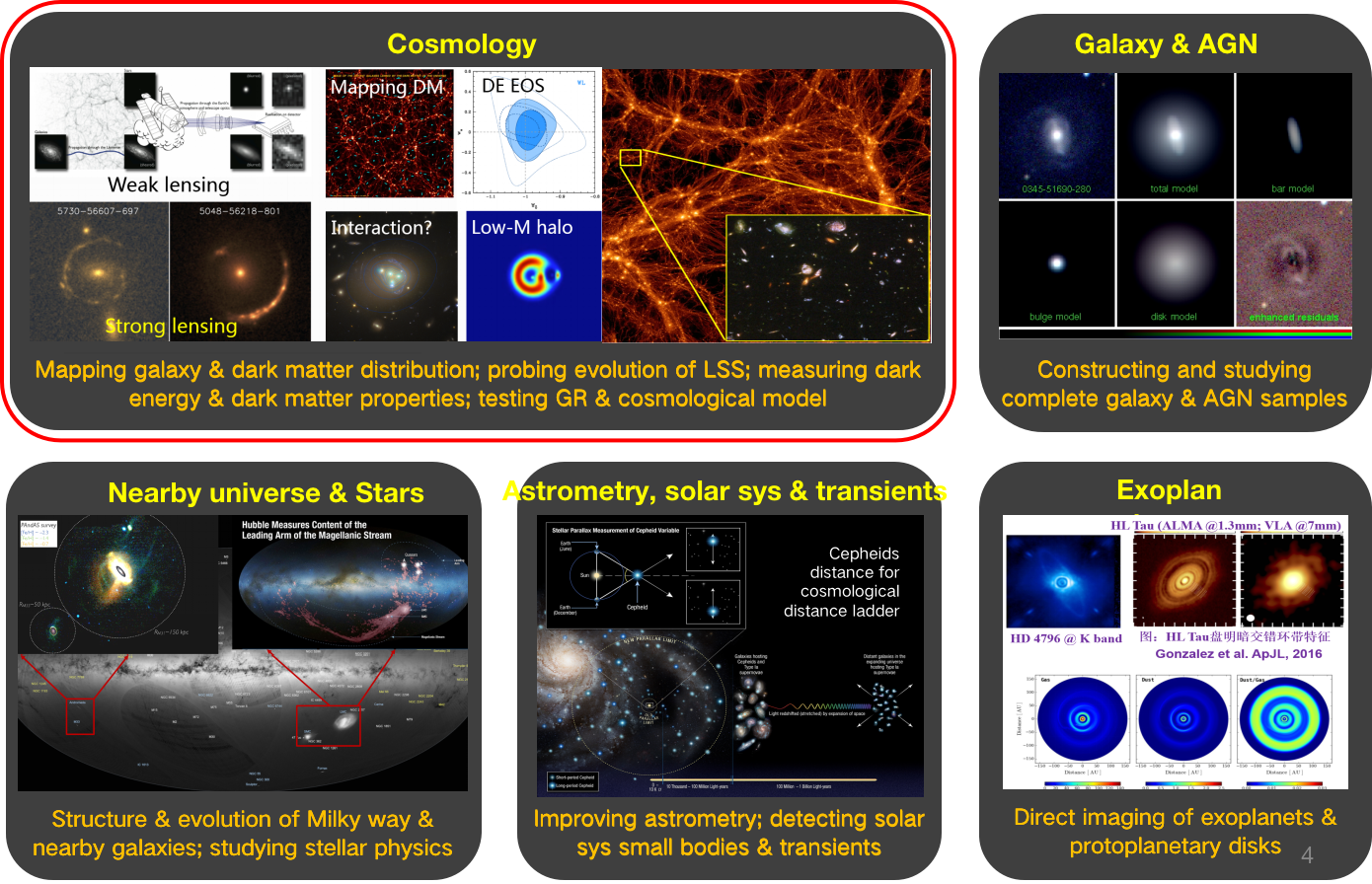
Cosmology
Cosmology is an important frontier of the science that studies the fundamental laws of the origin and evolution of the universe and matter. Using the observational data provided by the CSST large sky area survey and Ultra Deep Field observations, we are able to carry out both observational and theoretical studies of cosmology, which is an important area of scientific research in the CSST.
1. Accelerated Expansion of the Universe and Dark Energy
The CSST survey will measure the weak gravitational lensing, baryonic acoustic oscillation, redshift distrotion and galaxy clusters count, combined with the diffferent cosmological probes (Cosmic Microwave Background, supernovae, etc.), we are able to reconstruct the history of the expansion and structure growth of our Universe. The time delay of strong lensing multi-image can be used to estimate cosmological parameters, and to analyse the expansion rate and the spatial curvature of the Universe. And we are also able to test the dark energy model and gravity theory using those probes we mention above.
2. Dark Matter
The strong and weak gravitational lensing are perfect probes to reconstruct the underlying matter density field, and to mapping the density distribution of dark matter on different scales, and its evolution with respect to redshift. Combined with multi-wavelength observation, we can study the nature of dark matter particles (including their masses, self-interaction, interaction with baryon, etc.), constraint the cosmological parameters relate to dark matter, and study the co-evolution of dark matter halo and galaxy.
3.Galaxy Clustering and Large Scale Structure
The galaxy clustering, weak lensing, baryonic acoustic oscillation, redshift distrotion and galaxy clusters count, can be used to trace the underlying dark matter clustering, study the large scale structure and its evolution, constraint the cosmological parameters, study the properties of neutrino and primordial perturbation by combine with other cosmological probes (Such as, Cosmic Microwave Background, supernovae).
Galaxy and Active Galactic Nucleus
Galaxies are the fundamental units that form the visible universe. The formation and evolution of galaxies is one of the major topic of astrophysics. It’s a critical part of the CSST scientific goals to study the properties and evolution of the galaxies and massive black holes by utilizing the huge data sets from the CSST large sky area survey and Ultra Deep Field observation.
1.The Morphology and Evolution of Galaxy
Provide a rapid and automatic classification of galaxy morphology, study the central structure of galaxies, the evolution of the structure in different types of galaxies with respect to redshift; the structure decomposition and morphology of the AGN host galaxies; the correlation of the galaxy morphologies in muti-wavelength; the structures and morphologies of low redshift dwarf galaxies; the morphological features of the outer regions of galaxies; unveil the physical mechanisms of the evolution of galaxy.
2. The Environmental Dependence of Galaxy Evolution
Search the galaxy clusters, galaxy groups and cosmic voids. Study the physical and statistical properties of galaxies (luminosity function, mass function, etc.), key physical processes after the peak of star formation, strong emission-line and peculiar galaxies, the impact from different scales of environment on galaxies, galactic gas and galaxy properties and their connection with the environment.
3. High Redshift Galaxy and Reionization
Establish a sample of high-redshift Lyman Break Galaxy (LBG) and Lyman alpha Emitter (LAE); investigate the formation, evolution, physical properties and stellar population of high-redshift galaxies; using the high-redshift galaxies as a probe to study the large-scale environment of galaxies in the middle and late phase of the Epoch of Reionization (EoR).
4. AGN and Supermassive Black Holes
Establish a large sample of AGN and quasars. Study the co-evolution of galaxies and massive black holes; the structure, spectral energy distribution, photometry and spectroscopy variation and radiation mechanisms of AGN and quasars; the feedback and star formation in the host galaxies; statistical properties and cosmological evolution of AGN and quasars; and the peculiar types of AGN and quasar.
Milky Way Galaxy and Nearby Galaxy
The local group of galaxies, consisting of the Milky Way and its nearby galaxies, plays a significant role in studying the fine structure, formation, and evolution of galaxies, the influence of intergalactic environment on galaxies, as well as fundamental astrophysical and cosmological questions such as the detection of first-generation stars and constraining the nature of dark matter.
1. Stellar Populations in the Milky Way and Nearby Galaxies
Measuring the initial mass function of different stellar populations and revealing their correlations with metallicity, age, and stellar formation environments; investigating the origin of multiple stellar populations in star clusters; conducting observational studies on the physical properties of low-mass stars; studying the evolution history of the Milky Way using stars spanning a wide range of ages; discovering more tidal stellar streams in nearby galaxies and measuring their stellar population properties.
2. Extinction and Dust Distribution
Determining the interstellar extinction from near-ultraviolet to near-infrared wavelengths; measuring the spatial distribution of interstellar extinction in the Milky Way and nearby galaxies; studying the variations of extinction with interstellar and galactic environments; providing improved extinction models for the CSST. Constructing interstellar dust models to understand the fundamental characteristics of dust and its relationship with the environment.
3. Composition and Structure
Detecting the boundaries of the Milky Way, searching for additional substructures, and measuring the distribution of dark matter in the Milky Way and nearby galaxies; studying the geometric parameters of the Galactic disk structure and the bulge-bar structure; investigating the formation and long-term dynamical evolution of the Milky Way; searching for ultra-faint dwarf galaxies, mapping the structure of M31/M33, and constraining the cold dark matter cosmological model at the galaxy group level.
Astrognosy
Stars are the primary form of visible matter in the universe, and stellar physics serves as a crucial foundation for modern astrophysics. The study of star formation, structure, and evolution laws forms the basis for understanding galaxies and, in turn, the entire universe. It represents a frontier field in astrophysics.
1. Important scientific questions of binary stars
Obtaining a larger sample of binary stars with higher mass and mass ratios to study the statistical properties of binary populations as their internal varying with stellar parameters and environments; combining external spectroscopic observations to investigate the parameter distributions of spectroscopic binaries in different environments; developing more universal binary population synthesis models based on large samples of binaries in key evolutionary stages; constraining critical processes such as mass transfer and common envelope evolution in binary star evolution; studying accreting white dwarfs and related celestial bodies.
2. Stellar formation and evolution
Observing nearby stellar formation regions, distinguishing molecular clouds and dust extinction, and deriving column density maps; studying the accretion rates and binary fractions of different young stellar objects and exploring their relationship with mass to understand the formation and evolution of stellar formation regions in our galaxy; searching for Long Period Variable (LPVs), overmassive stars, and Wolf-Rayet stars to constrain stellar wind loss and binary evolution in massive stars.
3. Stellar activity and late-stage evolution
Studying the relationship between stellar magnetic activity and stellar evolution, as well as dense celestial objects such as white dwarfs, neutron stars, and black holes. Identifying and establishing a sample of white dwarfs to study the white dwarf luminosity function, stellar formation rates, and death rates. Investigating binary systems involving compact binary, supernova formation and stellar black hole binaries, to identify black hole candidates.Constructing the mass distribution of black holes and determining the masses of compact objects.
Astrometry based on CSST
The imaging quality and deep observation capability of CSST provide favorable conditions for the development of high-precision celestial measurements. This will significantly enhance and enrich the existing celestial reference framework, enabling improved accuracy and precision. Furthermore, it opens up new opportunities for advancing the fields of astrophysics and celestial measurement science, offering fresh prospects for research and exploration.
1. Establishment of a Deep Celestial Reference Framework
The establishment of a comprehensive celestial reference framework, encompassing deep extragalactic sources and near-infrared celestial reference frames, in alignment with internationally recognized celestial reference frameworks, aims to facilitate high-precision celestial measurements of near-infrared bright stars. This framework serves as a crucial calibration reference for positioning and attitude determination of observational data across various platforms. Furthermore, the integration of methodologies such as asteroid dynamics models and close encounter determinations enables the exploration of planetary ephemeris-related research.
2. Scientific Applications of CSST Celestial Measurements
The scientific applications of CSST's celestial measurements encompass the identification and orbital analysis of binary/multiple star systems, enabling the refinement of the structure and evolutionary models of the Milky Way through the utilization of near-infrared celestial measurement data. Additionally, these measurements find application in parallax determinations, facilitating the recognition of Cepheid variables, high-precision distance measurements of red giant branch tip stars, and investigations into stellar occultation events associated with solar system bodies.
3.Research on Relativistic Models in Celestial Measurements
Within the domain of celestial measurements, research on relativistic models encompasses the multidimensional data fusion for the authentication and mass determination of multiple star systems. Moreover, it involves the pursuit of searches for intermediate-mass black holes through astrometric measurements, as well as investigations into the mass determination of high proper motion celestial objects through the exploration of gravitational deflection. Additionally, the verification of the general relativity multipole moment effects via precise astrometric measurements forms a significant aspect of this research endeavor.
Exoplanet and Solar System Object
The detection and study of exoplanets and solar system bodies represent important frontiers and hot topics in current international astronomy. Leveraging the unique observational capabilities of CSST, conducting observations and research on exoplanets and solar system bodies will deepen our understanding of the formation and evolution of planets and the solar system.
1. CSST Exoplanet Observational Research
CSST facilitates the study of exoplanets within the Milky Way and neighboring galaxies through the utilization of coronagraphic observations for target selection, direct imaging of stellar circumstellar disks, and observations of exozodiacal dust. Additionally, investigations into exoplanet transit and microlensing phenomena enable research into the occurrence rates and orbital configurations of planetary systems, elucidating the distinctive characteristics exhibited by these systems.
2. Exploration of Exoplanetary Systems and Protoplanetary Disk
Research endeavors encompass theoretical and numerical simulations of exoplanetary systems, focusing on elucidating the properties and evolutionary patterns of cold and hot gas giants, as well as small-to-medium-sized planets. These investigations delve into atmospheric characteristics, evolutionary dynamics, interactions with host stars, and three-dimensional observations of protoplanetary disks. Furthermore, endeavors extend to the detection and statistical analysis of planets in the vicinity of white dwarfs and binary stars.
3. CSST Solar System Object Observations
CSST facilitates the discovery of a cohort of Kuiper Belt objects while enhancing the quality of orbital data pertaining to existing Kuiper Belt objects. Substantial augmentation of the dataset pertaining to high orbital inclination small objects is undertaken, accompanied by the search for main belt comets and the establishment of a comet physical parameter database. Statistical research focusing on near-Earth small objects in close proximity is conducted, alongside investigations into the composition, distribution, and evolution of active small objects. Additionally, the search and observation of irregular satellites orbiting large planets is pursued.
Transients/Variable Source and Significant Astronomical Events Response
Transient and variable sources, as well as sudden astronomical events, present rare opportunities to explore physics under extreme conditions. Given the current era of multi-messenger astronomy, CSST is poised to respond to significant sudden astronomical events and make distinct contributions.
1. Supernovae and Important Outbursts
Comprehensive endeavors involve the search for and identification of optical counterparts corresponding to transient sources, such as supernovae, via multi-parameter detections. The study of high-redshift Type Ia supernovae, serving as standard candles, facilitates investigations into dark energy properties, progenitor star models, diverse supernova explosion mechanisms, as well as first-generation stellar explosions and reionization phenomena. Coordinated multi-wavelength observations of supernovae, gravitational lensing by supernovae, and measurements of the Hubble constant constitute significant aspects of research pursuits.
2. CSST Response to Important Sudden Astronomical Events
CSST contributes to the search for optical counterparts associated with gravitational wave events, high-redshift gamma-ray bursts, tidal disruption events by black holes (TDEs), fast radio bursts, transient phenomena, high-energy neutrinos, and high-energy cosmic ray radiation sources. Optimization of observation strategies, coupled with multi-wavelength and multi-messenger research, facilitates time-domain astronomy investigations of significant sudden astronomical events. These endeavors enable a comprehensive exploration of the high-energy physical processes and mechanisms exhibited by the target sources.
Special emphasis should be placed on exploring and harnessing the unique characteristics of other terminal instrument modules in addition to the survey camera. Leveraging the multi-channel imaging instrument (MCI) of CSST, a comprehensive survey calibration star catalog can be established, facilitating enhanced accuracy in flux calibration and enabling deep observations of visible and ultraviolet ultra-deep fields. The integral field spectrograph (IFS) allows simultaneous imaging and spectral observations, facilitating in-depth investigations of specific targets. Furthermore, the exoplanet imaging coronagraph (CPIC) leverages its high-contrast imaging capabilities to undertake research on exoplanets and faint targets. The superconducting terahertz spectrometer (STS), with its distinct spectral band and resolution capabilities, enables observations of interstellar molecules and neutral carbon surveys, among other applications.